On the Nature of Art
“All art is at once surface and symbol. Those who go beneath the surface do so at their peril. Those who read the symbol do so at their peril. It is the spectator, and not life, that art really mirrors.”
Oscar WildeNature is a great concept, but we are never satisfied with it. Nature is always shown in conflict with nurture, not just in the sciences, but also in creative works where form is set against function as though they were sworn opponents.
Why do we do this?
Why does every serious human argument end up split in two? Good against evil, nature against nurture, form against function, spirit against matter?
What follows is my attempt to show that this habit is not simply useful, but misleading. Not entirely wrong, but not as fundamental as we take it to be. Our beloved divisions are shadows cast by a single light, and art is where that light briefly blinds us to the split altogether.
The Duality Effect
Man, viewed from afar, must surely be classified as the creature who splits the world into dual opposites. Everything suffers this surgery, from good being torn from evil, light being rendered from shade, man’s very nature being divided from that which nurtures it and in his art the maddening habit of splitting the form of things from their function.
Perhaps it comes from our dualist experience of reality, for the human lives in a world resplendent with physical doubles; two eyes to see with, two legs to walk upon and two hands with which to work.
But it is in language that this habit becomes unmistakable. Language is the torch in the cave of the human mind, and it illuminates by cutting the world into divisions.
Take the word “hand”. We say “on the other hand”, “left-hand path”, “right is right”. Even “sinister” comes from “sinistra”, the left-hand side. And it does not stop there. We divide not only left and right, but inner and outer. The world inside the head and the world outside in what we call “reality”.
This notion of “reality” is already doing something odd.
If reality is what lies outside experience, then how does the experiencer fit within it? The “I” becomes difficult to place. Not impossible, but uneasy. The more closely you look for it, the less solid it appears, as though it is constructed in the looking for it, rather than waiting there to be discovered. I will not push that further here, but it should make us suspicious of the neat split between observer and world.
How typical of Mankind to be the creature who splits the world in two and then places himself on the side of illusion!
Not much escapes what I have named the “Duality Effect”. By this I mean the human tendency to take a continuous experience and carve it into opposing halves, then forget that the carving was our own. Art, for me, is one of the places where that continuity is not argued but felt.
Science and the Map
Take science, the engine that built and powers the human world around us. Its method is to break the universe down into measurable chunks, then rebuild it into systems of behaviour. Useful. Communicable. Reassuring. But because science’s complexity is so difficult to hold in ordinary thought, it often gives rise to a simplified objectivist story. A popular myth of science, from which two things follow:
First, we confuse the map with the territory. Science models reality. It does not become reality itself. And yet I have sat in a lecture hall and listened to a scientist, with both tenure and conviction, argue that mathematics was truly real and that lived experience was, in some sense, not. Not a universal view, but a revealing one.
Second, we quietly demote the “inside”. The subjective becomes something slightly embarrassing, something to be explained away rather than taken seriously. We talk as though the subjective were an awkward relative hidden upstairs while the objective guests are visiting.
And yet the split is not clean in reality, even where we are not aware of it. For example, when you jump, your gravity pulls the Earth up just as it pulls you down. Only the scale differs. Reality behaves as though it is continuous.
Quantum theory unsettles this further. What we call a particle behaves less like a little billiard ball and more like a spread of possibilities in a field. Photons do not sit there waiting fully formed; they appear as particular outcomes of interaction. To observe something, in the everyday sense of looking, is to bounce radiation from it into our eyes; that interaction is itself within the field, and it affects the behaviour of the field all around.
In the Everett interpretation of quantum mechanics, our eyes and instruments are just more quantum systems: when light interacts with them, the combined system branches into different possible outcomes, each with its own version of “what was seen.” The light you “see” disturbs the system to the extent of determining which branch of the universe we are in. Therefore, measurement always disturbs what it measures because they are not really separate: the Universe is a continuous field. So, in a very real sense, looking at something introduces an interaction channel that changes its state and physically impacts what happens.
So, while it appears to us, while mired in our duality illusion, that we are separate from the observed thing, I am saying that the neat picture of a world “over there” and a watcher “over here” survives badly once you take these interactions seriously.
Physics now models reality as an interconnected continuum, which means anything that appears separated is actually joined at the quantum level. Moreover, your experience of reality is part of this continuum and directly affects your place within its many possibilities.
The Habit of Division
Indeed, we all grow comfortable with these divisions. So comfortable that when something is laid out neatly, step by step, we actually relax.
Wait a moment …
Did you feel a sense of relaxation just now as the explanation listed “two things”? Is your mental map, mental story, that there is an inside world and an outside world, cleanly split? For most, this dualism is endemic and permeates their entire being; religions often express the heart of it through feelings of the “divine”.
But I posit that there are moments when this story falls away, and the contiguous nature of reality is revealed. We do not think our way into them. Instead, we feel them. These moments, which remind you that you are continuous with everything else, are rare and hard to hold.
But they are real enough as experiences.
And they are precisely the kind of moment I will argue art is very good at producing.
“Art is made to disturb. Science reassures. There is only one valuable thing in art: the thing you cannot explain.”
Georges BraqueWhere Art Comes In
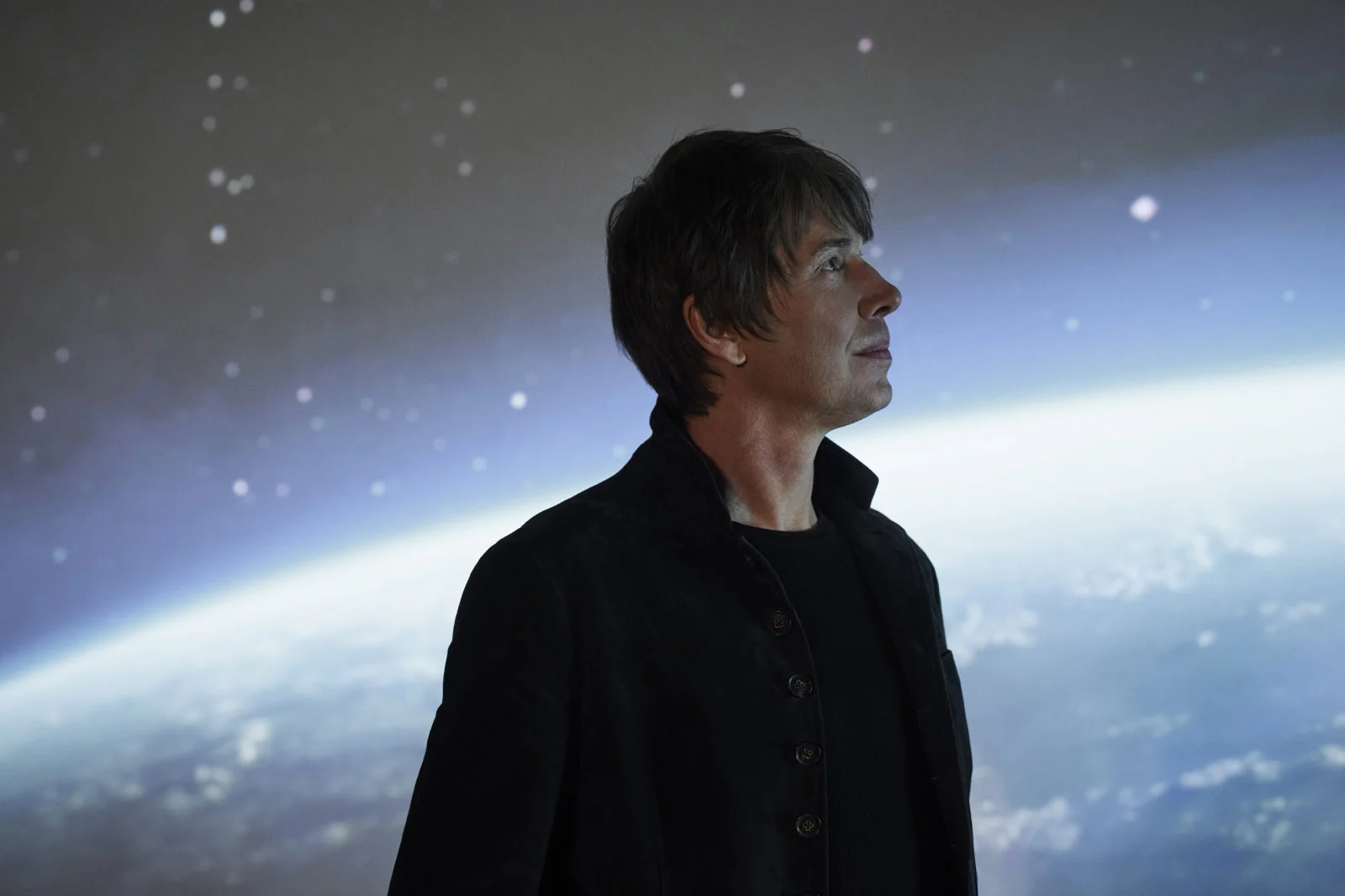
There are many ways to engender this. From religion to mathematics to chemicals, to dance. Even standing under a night sky, staring up with what I call a “Cox moment” of wonder.
But, I am interested in one that is available, repeatable, and human.
Art.
Art is not just nature, and not just abstraction. It is something made, and yet not fully controlled by the maker. Something that sits between intention and discovery.
“I found I could say things with colour and shapes that I couldn’t say any other way.”
Georgia O’KeeffeA Working Definition
We need to be careful here.
Art, as we usually use the word, is not confined to objects, nor even to recognised practices like painting or music.
Instead, it points toward a kind of experience; when I say ‘art’, I mean this.
Art is that moment when the usual divisions your mind imposes on reality fall away, and the world is experienced as continuous rather than split.
This can arise through painting, music, design, or performance. But it can also arise elsewhere.
In movement. In craft. In attention.
This definition may be stated in both hard and soft forms. Indeed, you may take it paradigmatically to mean that Art is characteristically the human endeavour which has this effect, or as a normative directive on what art is for. Myself, I think it is likely simply correct and that the property (illumination of contiguity) is both necessary and sufficient for being art. The fact that this raises broader issues in art and potentially excludes much of modern art is a problem for Damien Hirst.
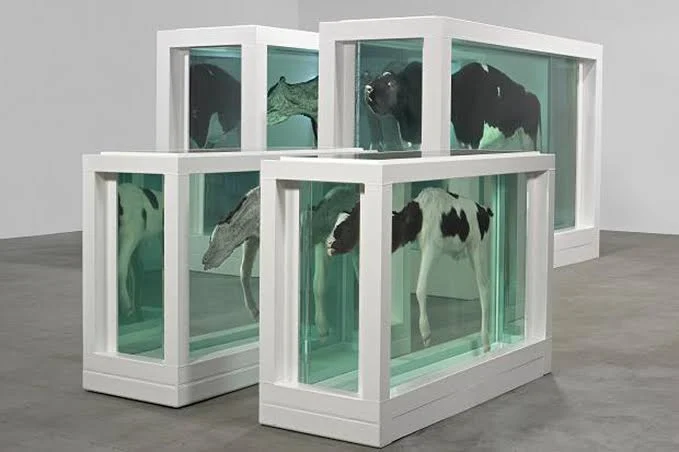
Because any deep aesthetic, expressive, or form-revealing experience counts as “illumination” of some aspect of reality’s continuity, this could be art – to you, or it might simply be a pun. If your understanding and experience of art becomes so tuned as to find such works to be art, then so be it.
I watched a lone piper, Major Paul Burns, walk away from the late Queen’s coffin, playing a final lament as he disappeared into the distance.
He was not performing for me. He was walking away from her resting place. And yet, for a moment, there was no split in my mind. No observer and observed. No subject and object. Just the sound, the movement, and whatever it is that I am, all happening as one thing.
It passed, as all moments do. But while it lasted, the stream of experience flowed as one with the river, and that is what I am pointing to.
We do not only bump into this state by accident. Art, in the sense I am using here, is one of the human ways of walking towards it on purpose, even though the moment itself never feels like a deliberate trick. Art, in the usual sense, is one of the most reliable ways we have of arriving there.
But it does not own the experience.
“Art enables us to find ourselves and lose ourselves at the same time.”
Thomas MertonForm, Function, and the Crack
We talk about form and function as though they were separate. A chair must function. It must support weight. Its form is how that function appears. Push the design too far toward function, and you get something brutalist; solid but ugly. Push too far toward form, and you get something beautiful but fragile, uncomfortable and useless.
So we aim for balance. But as we approach that balance, the distinction begins to dissolve. A well-designed object is not beautiful and useful as separate qualities. It is beautiful in its usefulness.
Eventually, language’s ability to keep that division going reaches the limit of words to describe the dualism and effectively gives up. You find yourself in a new region without “forms”, without dualistic dichotomy. A region of reality, and this region has a name.
We do not and cannot name the lived quality of the experience, but we name the feeling.
We call it art.
This is the word for where our ability to divide the universe fails, and for a brief moment, all too brief, everything joins back up, and we feel whole. This feeling for art is useful in one sense, as we can communicate the “feeling” succinctly, but we cannot communicate the thing in itself. That is why any normal definition of art is dry enough to be soulless and, by definition, cannot be this thing. It must, by virtue of our language, fall on one side of the “magnetic poles”.
Perhaps that is why “art” frustrates scientists and philosophers: it becomes subjective when defined in “split” terms. However, the feeling that the word “art” carries is not; it is the point where the coin of reality can no longer be flipped into heads and tails, where you can no longer separate the light from the dark, the left from the right and, most importantly, the judgement on a human endeavour that has achieved this blending sublimation.
On Making and Risk
From the artist’s side, this looks different.
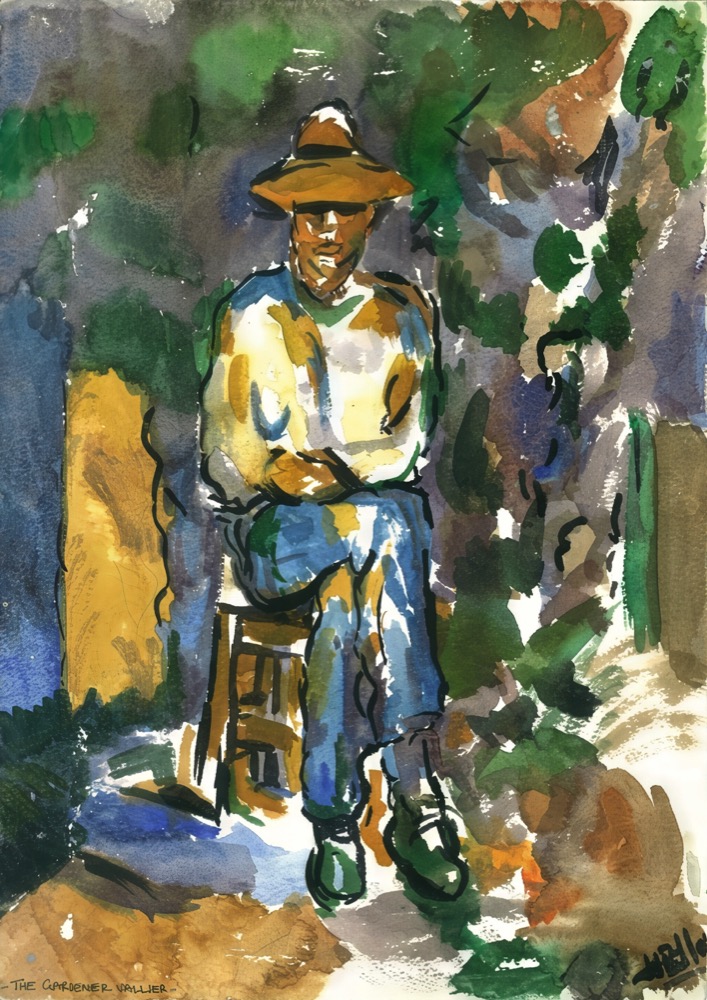
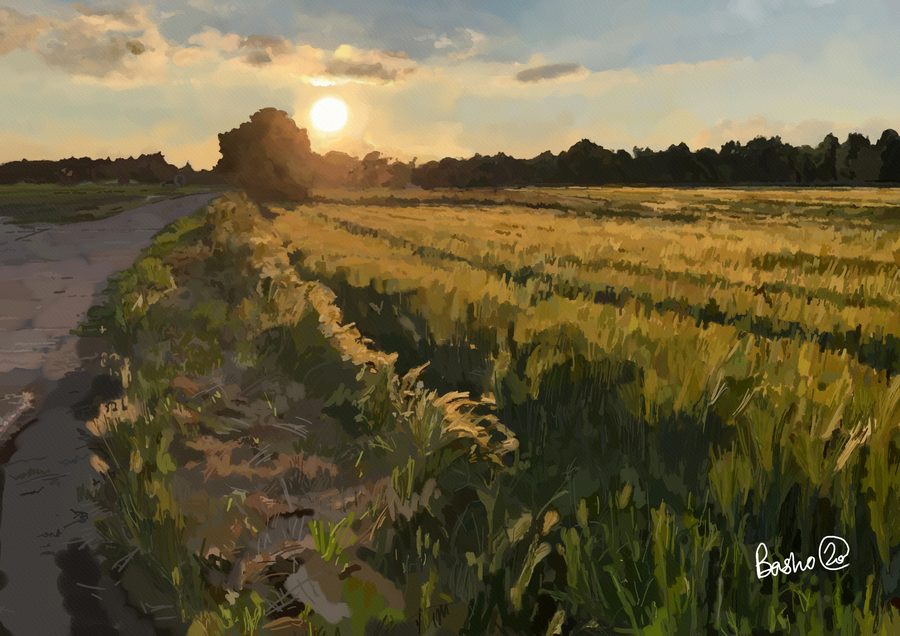
When I paint, usually in watercolours, I am, of course, trying to capture what I see. Anyone holding a brush is. But there is much more. I am actually trying to capture what I feel when I behold it. The hidden feeling inside the moment.
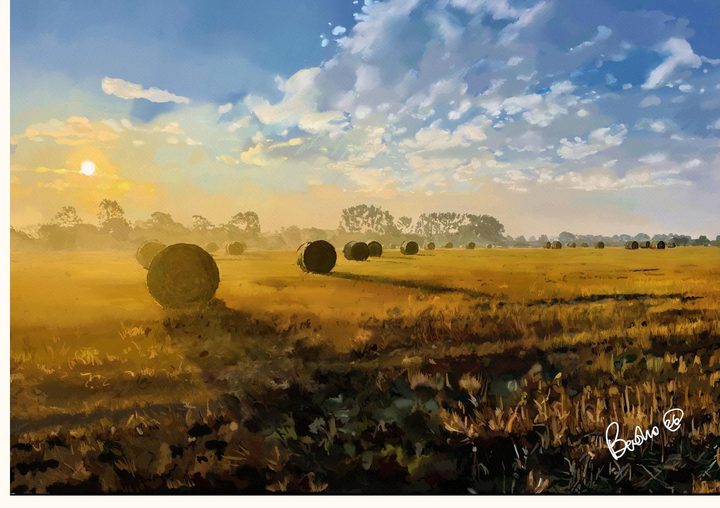
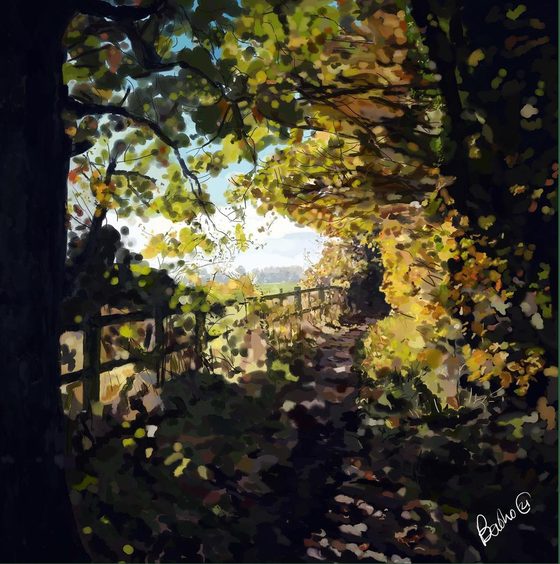
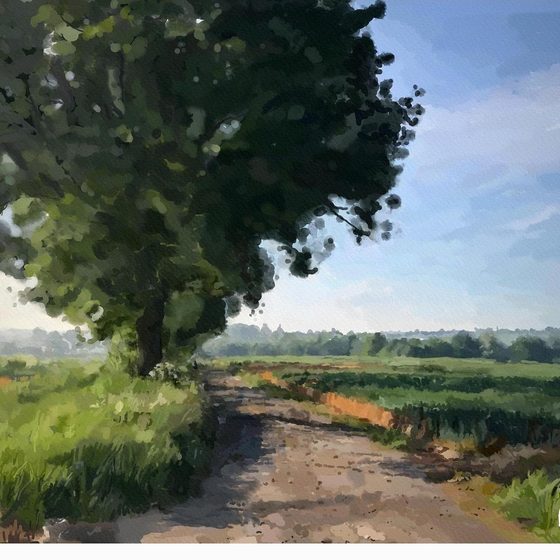
When I write, I am doing the same thing. Taking something that exists only in my mind and trying to pull it out onto the page. And in doing so, something strange happens. The original idea is replaced by its expression.
Something is lost, and something new appears.
This is where risk enters. Creating art is not copying; it is reaching; trying to catch something that does not want to be caught. And you can miss.
At its best then, an artwork carries a trace of the moment that birthed it. Enough that someone else might encounter it and fall, briefly, into the same continuity.
Art is that which does this.
Put another way, art is whatever succeeds, however briefly, in making “me” and “it” indistinguishable. In revealing that what I see, what I feel, and what I am are not two separate things, but one continuous event.
What About Modern Art?
Modern art plays directly with this, and often by pushing form to the point of total abstraction. Take Mark Rothko, who paints huge slabs of colour. Entirely balanced together to engender a feeling, and often not a nice feeling. I found they gave me unease, stillness, even dread when viewing a huge gallery of them in New York on a recent visit.
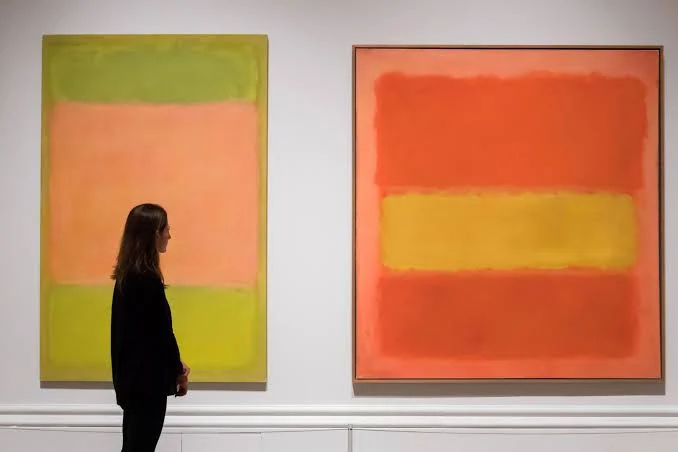
Sometimes such experimentation works, and sometimes it does not. For example, Duchamp’s “Fountain” urinal either opens something in your heart, or you’re likely to only recognise it as an object. If it breaks your categories, it functions. If it does not, it remains plumbing.
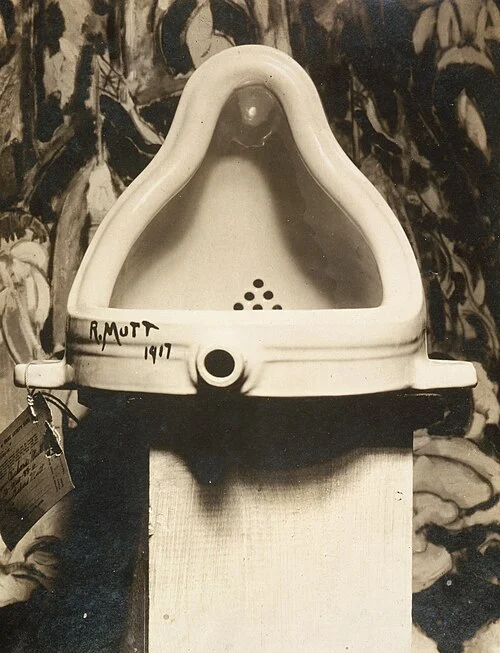
That is not a failure. It is a reminder. Art is not only in the object. It is in the encounter.
Considering Alternatives
How does this definition improve on others? Let us consider the most common ones.
Institutional Theory , from thinkers such as Dickie and Danto, will likely be the theory of art encountered in schools and colleges. This claims that the “artworld” itself has the right to designate something as art or not. Usually, by virtue of that thing being in a gallery. That there could exist these representatives of the “artworld”, a sort of Ongo Gablogian figure who pronounces what is or is not art, is not only circular but ridiculous bureaucracy. What if such a person is not around to designate it so? Does it stop being art without sending for the appointed administrative artworld representative to decide on the Universe’s behalf?
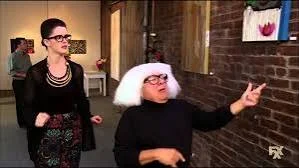
My definition needs no interlocutor, and enables one to make their own pronouncements.
Gaut’s Cluster theory abandons this notion, but itself is mired in overlapping and competing expressions of words. Fixed in the language of dualistic thinking, leaving aside entirely the expressiveness and liveliness of art. Trying to please everyone pleases no one and misses the entire point. This sort of thinking is how we train AIs, and I am not too sure they are the best example of truth with which to define anything.
Whereas we have investigated the why entirely. Gaut’s cluster of definitions is mired in the impact of dualism on language. It records which properties tend to appear together without explaining why those properties matter at all. We, here, have nailed the very centre missing from the nest.
Historical and Intention-based theories, such as those of Levinson , on the other hand, select objects based on the creator’s intention to match the historical regard for art, placing the past entirely above the absolute present moment. I don’t care whether Dada’s work brought the art experience to the minds and hearts of those in the past; I care only about the feeling I have right now. Saying that this current feeling is only valid because the subject, in some way, is characteristically similar to prior works is ontologically useless.
My definition is grounded in the now, the moment in question; forging a new record independent of the condition that someone else felt the same once. Maybe.
Finally, Family Resemblance views simply give up and argue that the definition is too hard to capture in words. This is the correct first step, but instead of realising why it is, and taking the second, they simply create a series of overlapping definitions circling around the true nature of art as horseshoes pitched around the post in the game of Quoits! No wonder then it was popularised by the master of all language games, Wittgenstein . What he would make of modern commercial “art” is perhaps best left to speculation.
My definition sublimes the difficulty by removing the need for dualistic notions pulling in different directions. By containing the risk of being wrong, you are actually saying something worthwhile in the first place.
Conclusion
Art names those moments where the divisions we habitually impose on the world fall away, and reality is experienced as continuous rather than split.
Not the object. The moment.
It is not just a feeling, but a shift in how experience is structured. The difference between describing a thing and being caught in it.
But not everything is art. While the category is broad, the occurrence is rare.
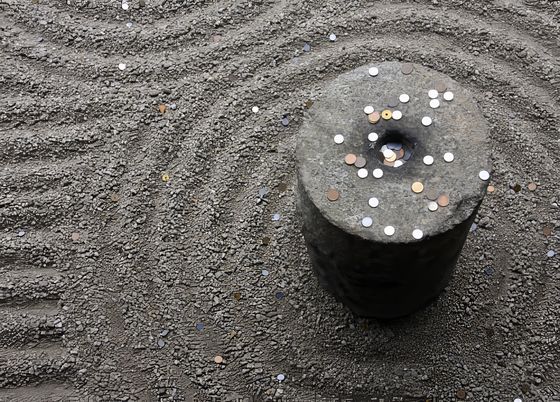
Zen philosophy has been making this point for quite some time, and Zen gardens are art exhibits designed specifically to create this feeling.

So, are they mountains or islands? Neither, they are rocks! The mind imposes shapes and patterns on the world outside that don’t really exist – just like, and here comes the point,
Your “self”.
You ascribe a duality to yourself. That is, you have a mental point of view called “You” and this is distinct from everything else. The purpose of a Zen garden is to show, by way of example, by way of a question with a sudden realisation of an answer, that there is no self, no duality of you and the Universe, you are what the Universe is doing right now and, eventually, this doing will stop. Your imagined self is just like the flag, just like the stones, no more than a “projection” your mind makes moment by moment.
Now that, my friends, is gardening!
Trials & Tea CeremoniesCould we then use a different word than “art” for these emotional moments? The word ‘art’ is messy if you think it must classify objects. I am suggesting it points to a kind of experience. We already use it that way: ‘That was art’ is often said of something that never hung in a gallery. Your judgement about what triggers it is subjective, but the experience itself is not arbitrary. People disagree about the triggers; they do not disagree that such moments exist.
If we apply a judgement to whether something is or is not, the praxis is to ask whether the creative outcome was guaranteed; if so, then you are executing, not discovering.
Final question: “Why does any of this matter?”
Because most of the time we live inside our divisions as though they were absolute. Every now and then, something breaks them. Those moments feel different. Clearer. Stranger. More real.
We gave those moments a name.
Art.
“It is the spectator…that art really mirrors.”
Oscar WildeThe watercolours in this essay are my own. You are welcome to see more of them, and Cesca’s photography, at our studio .