The Four Goals That Run Every Training Programme — And The Adaptive Engine That Serves Them

“Aesthetics” is simply hypertrophy with a specific visual slant. “Just get me training” is a default for the undecided. But the four truly meaningful goals, established as distinct physiological processes by sport-science literature, are:
- Get Stronger
- Build Muscle
- Lose Weight
- Feel Healthier
Each one trains a different system. Each one has a different evidence base. Each one demands a different discipline, a different volume profile, and an entirely different relationship to fatigue. The most common reason lifters stall isn’t a lack of effort—it’s training for one adaptation while expecting another. A powerlifting program won’t carve a lean physique if the diet isn’t dialled in, and a high-volume bodybuilding split will absolutely crush a busy executive trying to intermittently fast.
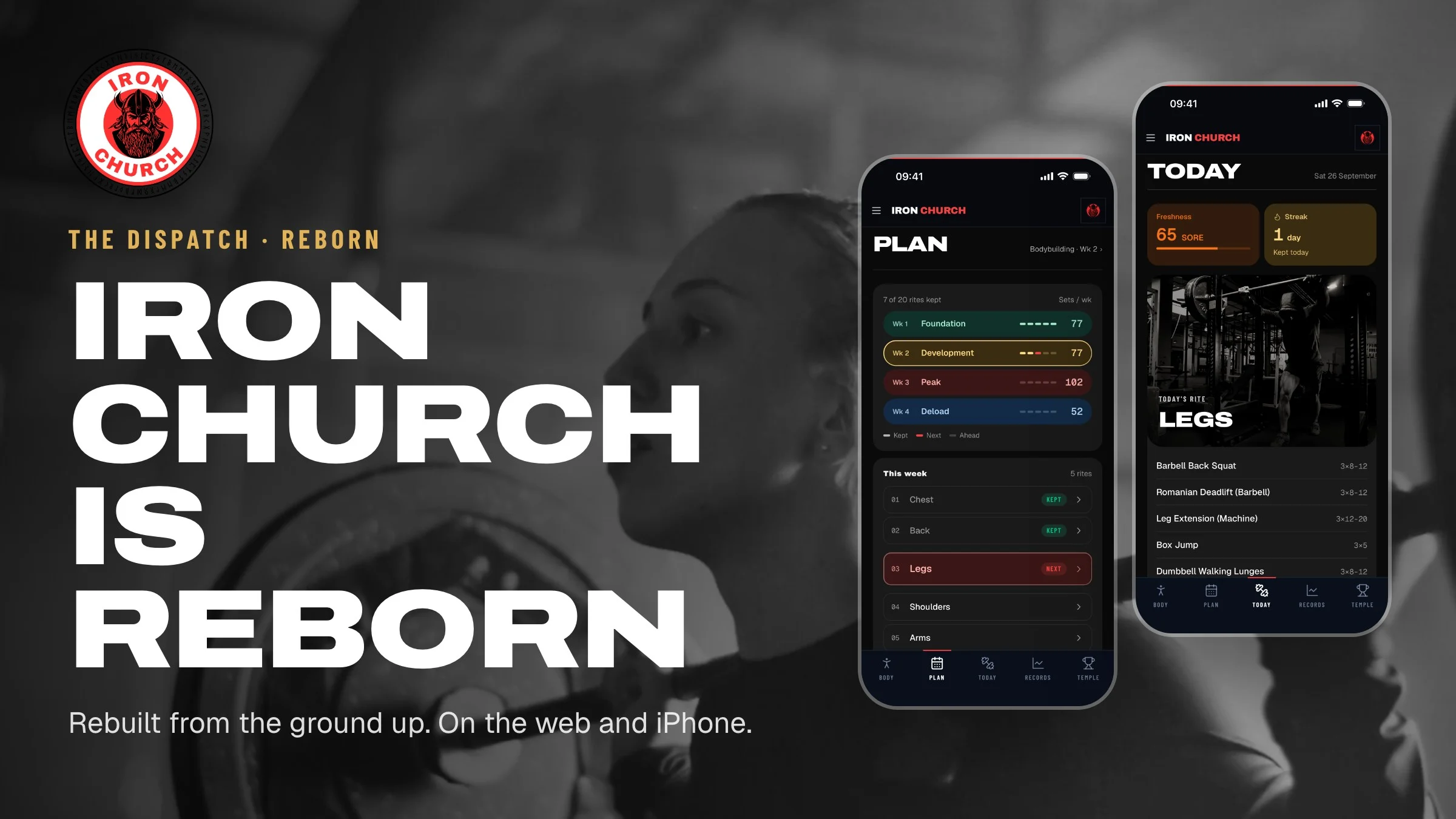
Here is what the science says, how Iron Church’s deterministic engine actually delivers it, and how the system dynamically adapts to fatigue, deloads, and fasting when real life gets in the way of perfect programming.
1. Get Stronger — The Neural Goal
Strength is not simply a bigger muscle. It’s a better-wired one. Before your body invests the massive metabolic resources required to build new muscle tissue, it will first attempt to optimise the tissue it already has.
When you lift heavy and lift it often, the main adaptation in the first 4–8 weeks is strictly neural. It acts like a software update for your central nervous system. You improve motor unit recruitment (better and more violent activation of muscle fibres by nerves), rate coding (how incredibly fast nerves send those firing signals), and intermuscular coordination (the ensemble of how well different muscles work together to stabilise and move the weight) (Folland & Williams, 2007).
Strength gains are highly load-dependent (Schoenfeld et al., 2017). You have to lift heavy—typically greater than 80% of your 1RM—to maximise these nerve pathways and convince the brain that producing high-end force is a mandatory survival skill.
How the Engine Serves It: Because heavy, low-rep compound lifting creates immense CNS (Central Nervous System) fatigue, the Iron Church engine strictly monitors your absolute intensity. Unlike normal muscle soreness, CNS fatigue is systemic—it presents as profound lethargy, a measurable drop in grip strength, and a generalised heavy feeling.
To manage this, the engine tracks your e1RM (Estimated One Rep Maximum) dynamically and uses a Mesocycle Position Tracker. This subsystem meticulously watches your progression through a multi-week training block. It automatically identifies when you have entered a peak-intensity week and—crucially—intervenes by triggering a mandatory deload week. This programmed reduction in load allows your nervous system to recover, supercompensate, and express newly acquired strength before you burn out and regress.

2. Build Muscle — The Hypertrophy Goal
If strength is about the nervous system, hypertrophy is about cellular architecture. Building muscle requires mechanical tension—subjecting the muscle fibres to a physical stretching and contracting force under load that creates micro-trauma and triggers a cascade of chemical hypertrophy signals.
Unlike strength, hypertrophy isn’t strictly tied to ultra-heavy weights. You don’t need to pile plates on the bar until your joints scream. The current scientific consensus unequivocally shows that muscle growth can be achieved across a remarkably wide variety of rep ranges, provided the sets are taken sufficiently close to absolute muscular failure (Lasevicius et al., 2022). It is the grinding, uncomfortable sensation of forcing a muscle to contract when it is already exhausted that drives hypertrophy.
How the Engine Serves It:
Hypertrophy requires volume (the total number of hard sets you do per week). However, more volume is only better until it’s not. The fitness industry commonly glorifies “junk volume”—mindlessly adding extra sets that yield zero additional growth but dig a massive, systemic hole in recovery.
Iron Church manages this razor’s edge via the MRV (Maximum Recoverable Volume) State Engine. This background tracker continuously calculates your trailing 7-day training volume for each muscle group using an exponential decay model (which weights your most recent, fatiguing workouts much more heavily than older ones). It automatically intervenes to cap your daily and weekly volume just before you exceed your body’s biological ability to recover and repair.

3. Lose Weight — The Energy Deficit & Fasting Layer
When the core goal is fat loss, your training’s primary job isn’t actually to burn calories—it is to signal your body to violently hold onto its muscle tissue while the nutritional deficit does the hard work of burning fat.
Muscle is metabolically expensive. If you are in a caloric deficit and aren’t actively giving your body a good reason to keep muscle via heavy mechanical tension, it will happily burn that muscle away for fuel alongside your fat. Resistance training paired with adequate protein intake is highly protective of lean mass during this deficit (Longland et al., 2016). If you just diet without lifting, you become a smaller, weaker version of yourself. If you lift while dieting, you achieve true “Body Recomposition.”
Integrating the Fasting Layer:
Because nutrition dictates weight loss, many users employ intermittent fasting or OMAD (One Meal A Day) to easily maintain their caloric deficit. This introduces a major physiological variable: training while deeply fasted. Training in a deep fast alters your blood glucose dynamics, raises your baseline cortisol, and fundamentally changes your stress profile.
This is where Iron Church’s deterministic code steps in to prevent physiological crashes. The engine doesn’t just look at what you should lift; it looks at when you last ate.
- Session Interference Detection: A safety mechanism triggers when you attempt a heavy, CNS-taxing workout (like heavy squats or deadlifts) while deeply fasted. Pushing for a maximum lift at hour 18 of a fast isn’t just suboptimal; it’s a recipe for severe form breakdown and injury. The system will automatically adjust exercise selection, swapping highly technical lifts for safer alternatives, and modulate volume to match your current, glycogen-depleted physiological capacity.
- Readiness Penalty Coefficient: If your fasting periods consistently exceed optimal thresholds, the engine applies a mathematical adjustment to your session targets, actively lowering your expected RPE (Rate of Perceived Exertion) to protect you from systemic central nervous system burnout.

4. Feel Healthier — The Longevity Goal
Not everyone wants to step onto a powerlifting platform or onto a bodybuilding stage. For those looking to dramatically improve their longevity, joint health, and day-to-day cardiovascular capacity, the “Iron Church” approach shifts fundamentally from raw intensity to sustainable, pain-free consistency. This is about building an unbreakable body that thrives outside the gym.
Research indicates a profound “sweet spot” for resistance training in terms of health benefits, with a highly significant reduction in all-cause mortality from just 1–2 moderate-strength sessions per week (Momma et al., 2022; Saeidifard et al., 2019). Beyond that, returns diminish for general health.
How the Engine Serves It:
For the “Feel Healthier” track, the engine permanently lowers the overall CNS load threshold and introduces Metabolic Finishers. Instead of asking you to mindlessly jog on a treadmill for an hour, these are dynamically generated, on-demand conditioning blocks placed at the tail end of a workout. They are custom-built around your available equipment—perhaps combining kettlebell swings, farmer’s carries, and sled pushes. They drive mitochondrial efficiency, increase heart health (locking you into Zone 2 and Zone 3 cardiovascular parameters), and maximise energy expenditure without demanding the extensive, multi-day recovery time that heavy barbell lifts require.

The Engine That Orchestrates It All: The Adaptive Stack
Periodisation—the systematic planning of exercise phases over months and years—is absolutely necessary for long-term physical success (Williams et al., 2017). But static PDFs and spreadsheets are profoundly flawed. A spreadsheet assumes you are a perfectly recovering machine in a vacuum. It can’t adjust when you have a terrible night of sleep, it doesn’t know you missed lunch, and it cannot recalculate your maximum recoverable volume when life inevitably gets in the way.
Instead of relying on unpredictable, generative “AI,” Iron Church relies entirely on deterministic code. Generative AI hallucinates; it might program 10 sets of deadlifts simply because a language model recognised that as “intense.” Deterministic code, however, relies on hard mathematical boundaries—if your calculated fatigue exceeds a specific threshold, your programmed volume structurally must decrease. It follows predefined, mathematically sound rules to adjust your programming on the fly. We call this the Adaptive Stack.

Ultimately, your body doesn’t know what a workout program is, and it certainly doesn’t care what a spreadsheet says. It only recognises stress, recovery, and adaptation. By choosing the exact right goal and allowing a deterministic engine to flawlessly manage the stress variables, the physical adaptation becomes inevitable.
Hopefully, you have found this article interesting – please feel free to ask any questions.
The next in the series is about programming for the “Golden Age” bodybuilding, and providing software for training in the gym with a partner – just like Arnie did back in the day at Gold’s Gym – or even in different gyms anywhere in the world!
Regards,
Basho
———————————
Glossary – If you are lost with all the terminology, click here
Selected Works Cited
- Folland, J. P., & Williams, A. G. (2007). The adaptations to strength training: morphological and neurological contributions to increased strength. Sports Medicine, 37(2), 145-168.
- Hall, K. D., & Guo, J. (2017). Obesity energetics: body weight regulation and the effects of diet composition. Gastroenterology, 152(7), 1718-1727.
- Lasevicius, T., et al. (2022). Muscle failure promotes greater muscle hypertrophy in low-load but not in high-load resistance training. Journal of Strength and Conditioning Research, 36(2), 346-351.
- Longland, T. M., et al. (2016). Higher compared with lower dietary protein during an energy deficit promotes greater lean mass gain and fat mass loss: a randomised trial. The American Journal of Clinical Nutrition, 103(3), 738-746.
- Momma, H., et al. (2022). Muscle-strengthening activities are associated with lower risk and mortality in major non-communicable diseases: a systematic review and meta-analysis of cohort studies. British Journal of Sports Medicine, 56(13), 755-763.
- Morton, R. W., et al. (2018). A systematic review, meta-analysis and meta-regression of the effect of protein supplementation on resistance training-induced gains in muscle mass and strength in healthy adults. British Journal of Sports Medicine, 52(6), 376-384.
- Saeidifard, F., et al. (2019). The association of resistance training with mortality: A systematic review and meta-analysis. European Journal of Preventive Cardiology, 26(15), 1647-1665.
- Schoenfeld, B. J., et al. (2017). Strength and hypertrophy adaptations between low- vs high-load resistance training: a systematic review and meta-analysis. Journal of Strength and Conditioning Research, 31(12), 3508-3523.
- Williams, T. D., et al. (2017). Comparison of periodized and non-periodized resistance training on maximal strength: a meta-analysis. Sports Medicine, 47(10), 2083-2100.