Not since ancient times has a movie so polarized critical opinion.
Is the movie racist? Was it boo’ed in Germany? Did the London Metro really give it 1 star?
It seems that the Spartans continue to confound today’s commentators as much as they did their contemporary Greek states. I saw the movie last night in a packed cinema along with my brother and here I am going to review the film, script and the personality of the Spartans. Because never have I read more stupid and ill informed reviews than those of this film.
Style is something that cinematically speaking is like marmite; you either love it or hate it.
Stylish laiden movies have spawned entire themes of film making. Movements that we today totally take for granted and therefore totally forget the risks these films were taking at the time. Film noir is one such style. The Film Noir style is, these days, only shown as a caricature of itself. A piss take. Older film noirs like The Third Man, Maltese Falcon and such like are now lauded as classics of a lost genre. A stylistic phase that is now out of fashion and no longer valid as a future medium. In effect judged as too stylish. But then film is like fashion in more ways than one; they both come back around again. Consider that the sword and sandaled genre was deader than dead and then consider that it came back with a bang. Super hero comic adaptations, WW2 movies, monster flicks, etc.
It is a new version of the noir.
Film noir is a cinematic term used primarily to describe stylish Hollywood crime dramas, particularly those that emphasize moral ambiguity and sexual motivation. Hollywood’s classic film noir period is generally regarded as stretching from the early 1940s to the late 1950s. Film noir of this era is associated with a low-key black-and-white visual style that has roots in German Expressionist cinematography, while many of the prototypical stories and much of the attitude of classic noir derive from the hardboiled school of crime fiction that emerged in the United States during the Depression.
Film noir, after it dropped out of fashion last rotation, went to the comics. Where the large shades of black lend themselves well to the comic structure of heavy print, short prose and larger than life action. The comic has embraced this genre because of the dark underbelly it presents. The narration fits the simplistic depiction of good and evil and the ability to amp up characters.
Frank Miller is considered the one of the most popular and successful of these writers. This combination has led to the production of a new cinema style; noir movie comics. Sin City is the leading example. High tech replaces true shadows, colours that exist only in the mind, impossible film shots generated through computer and violence expanded and written large on the screen. Consider Sin City; nothing much happens and a lot of people get dead. Yet still it is considered a great film. A comic book story, its characters painted so large and in black and white that the movie didn’t even attempt to add depth. Instead it relied on its actors to carry the story unspoken through looks, smiles and sexual tension…
Ah! truly then the noir is back! Sexual tension is the core to all good noirs.
And so we come to 300. An adaption of a comic noir that is itself adapted from a real historical event. This story is not a myth. This actually happened.
On paper the Spartans are perfect for the noir movie comic treatment. Colorful, amazing, larger than life, anachronistic, laconic, brave, violent and most immortally kick-ass. What better story could their be than the stand of king Leonidas and his 300 against over 250,000?

Sadly, the majority of the reviews have totally missed the point.
Let us consider this film. The whole story is told as a flashback. This is used as a device to setup the over the top’ness found in the story. The narrator is Aristodemus, who (in RL) was the last survivor of the 300 and sent back to report on the Spartans and what they died for. In the film this was portrayed as a political maneuver on the part of the king to galvanize his resigned nation to action and to inspire them and this inspiration is what Aristodemus is doing as the film opens to the Spartan army about to fight the Battle of Plataea.
In reality Aristodemus did survive until Plataea but he was considered a coward for leaving the 300 and his manically fevered fighting conduct only isolated him further.
So, who were the Spartans?
The Spartans were Dorian, that is made up from one of the principle Greek tribes of the BCE era. Their domination of the Greek world (before Alexander) was a short lived but they were for 30 or so years the most powerful force in the ancient world. Their society was based on a mixed combination of democracy and a strange dual kingship. Considered barbaric and basic by their contemporaries, their lives were totally focused on war, and from age 7 to 60 a Spartan man could easily be called to battle. The Spartans killed any of their young that didn’t meet their biological requirements. This is a primitive form of Eugenics found in many small nation clans such as the ninja’s of Iga who did exactly the same. This program of indoctrination and harsh training bred a large a very skilled army of professional soldiers that really stood out in combat.

Back then the middle-class professional soldier was the norm and mercenary troops plied their skills up and down the Greek peninsula fighting for city states alongside the citizens themselves. Since a professional soldier had to supply his own armor and weapons battles were often more a case of working out who was on which side (especially when they often switched mid-battle). In contrast Sparta provided all its warriors with their equipment and thus the Spartan battle formation really stood out and this means that their appearances on the battlefield are well recorded.
The Spartan fighting man in the film is shown almost how he looked in life except for a few things. Firstly the Hoplite warrior was, for his time, very heavy infantry.

The word hoplite (Greek ???????, hoplit?s) derives from hoplon (?????, plural hopla, ????) meaning an item of armor or equipment and consequently the entire equipment of the hoplite (but not specifically the circular shield, which is sometimes incorrectly referred to as a hoplon, though it was in fact called an aspis). These soldiers probably first appeared in the late seventh century B.C. They were a citizen-militia, and so were armed as spearmen, and assumed a phalanx formation, which are relatively easy to equip and maintain; they were primarily drawn from the middle class, who could afford the cost of the armaments. Almost all the famous men of ancient Greece, even philosophers and playwrights, fought as hoplites at some point in their lives.
Socrates for one.
One of the main things the film changes is that the Spartans don’t wear armour. In real life the Spartans were used to acting as shock troops and of course wore heavy breastplates to prevent, you know, death from sharp objects…
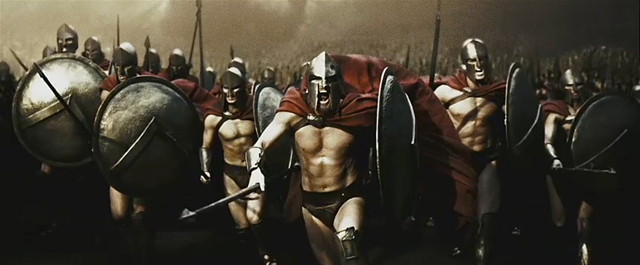
Anyway, it is a fact that on the march to battle they did not. The armour was so heavy that it was only put on just before the battle started. The other thing that is missing is that the Phalanx relies on much longer spears than those shown on screen. This is a more forgivable error since a movie depicting a battle as a simple push and stab would have been very boring and looked slightly silly to modern eyes.
The scenes in Sparta and in the homelife of the king build the tension well as he wrestles with his decision to go to a war he may lose. However in reality Leonidas sent the 300 because it was all he thought he needed to hold the pass and the political shenanigans depicted is not actually accurate. The scene with the Oracle pronouncing that Sparta should not go to war actually went something like this:
O ye men who dwell in the streets of broad Lacedaemon!
Either your glorious town shall be sacked by the children of Perseus,
Or, in exchange, must all through the whole Laconian country
Mourn for the loss of a king, descendant of great Heracles.
He cannot be withstood by the courage of bulls nor of lions,
Strive as they may; he is mighty as Jove; there is naught that shall stay him,
Till he have got for his prey your king, or your glorious city.
Which is not exactly “stay at home” message given in the movie. Still I noticed people being stirred by that scene of titillation followed by the sex scene between the king and queen that quite set the mood and raised the blood in time for it being let loose in the battle.
This sort of cinematic and classic emotional cross over technique is used in almost all movies. But never the less, even though I was aware of the technique, I was titillated along with everyone else.
The Battle.
The basic premise setting up the battle of September 480 BCE is not quite correct. The Persian empire was not totally made up of slaves and the Spartans were not totally freedom loving Democrats, but the basic fact is that their way of life was directly threatened by Xerxes invasion.
The fact that the Spartans had slaves themselves is neither here nor there. Ancient peoples cannot be judged by modern standards. To do so is a total waste of time and something we should not encourage the future generation to do to us! Nevertheless the comic sensibilities is clearly drawn into black and white by the King asking the Thespians what their professions were and receiving “Potter and sculptor” as the replies!

Once in place the events of the first day and the subsequent end of the great warriors (thus giving away nothing you don’t already know) is almost accurate and mixed in with the Queen’s political struggles back home. However, while the depiction of the Medes (ancient Iranian people) is correct in their attire and martial prowess, the depiction of monsters is frankly silly. One could be forgiven for thinking that you were watching Lord of the Rings at one point, with the hero battling a giant Troll…
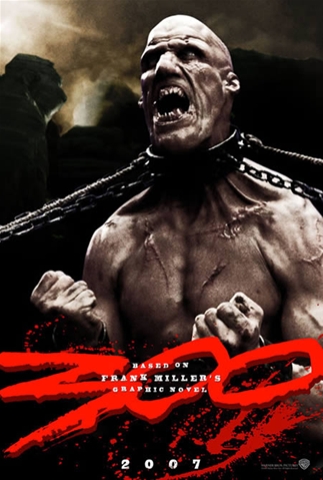
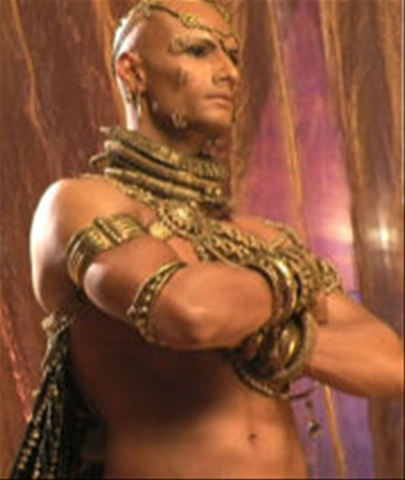
…I mean Maniac one-on-one. The shots echo the Aragon-versus-Troll battle (at the end of the Return of the King) almost frame by frame. Moreover the depiction of Xerxes himself is also almost funny as he appears as a giant 7ft tall androgynous fruitcake rather than the land hungry, irate bastard he was said to have been.
I was put in mind of the main antagonist in the movie Stargate.
 or
or 
Oh, and there were no Oliphants… I mean Elephants, in the real battle.
This apart the story of the battle is almost correct. The real Immortals actually wore scale mail-like plate amour and carried wicker shields and bows. They were more suited to desert warfare where there is space to move and retreat they faired no better that the Medes against the Phalanx, something Xerxes should have seen coming. In the movie they are a cross between samurai, ninja’s and Stormtroopers.
However by far the worst departure from the real story is the character of the traitor; Ephialtes. Here he suffers from the same treatment that Shakespeare meters out to Richard the III is that he is a hideous hunchback. Again clearly delimitating between the perfect Spartans and their adversaries.
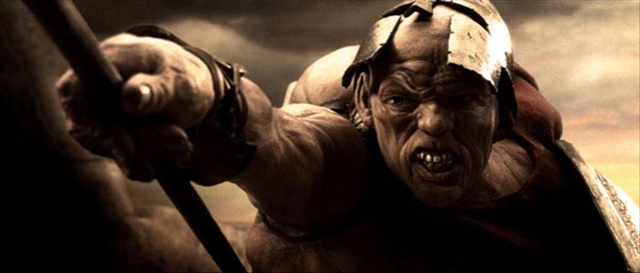
The name Ephialtes is the archetypical word for traitor in the Greek language, much in the same way one might call someone a “Judas” or “Quisling”. I suspect that he was not a popular chap with the Greeks and legend has it he moved abroad soon after the battle. The aftermath of the battle is handled quite correctly: The Spartans died to a man with their king’s corpse being mutilated by the Persians as a warning.
This did not have the required effect and soon both the film and the real history pass on to the Battle of Plataea. This took place in 479 BC between an alliance of the Greek city-states of Sparta, Athens, Corinth, Megara and others against the Persians and with it the Persians were expelled from Greece forever.
In other words, the sacrifice of the 300 worked.
The film’s director stated in an interview that “The events are 90 percent accurate. It’s just in the visualization that it’s crazy… I’ve shown this movie to world-class historians who have said it’s amazing. They can’t believe it’s as accurate as it is…
[the films is] an opera, not a documentary”.http://www.city-journal.org/html/rev2007-03-07vdh.html
So whats up with the reviews?
It is in the lack of understanding of the ancient Greeks that has mostly led to the mixed reviews of the critics. Some don’t realise that this event actually happened and that it is not like “Troy”. Others point to the correlation of good and bad, democracy and monarchy and draw parallels with the Iraq conflict. At some high level the studio probably realised that there could be a correlation and thus green lighted the film, but and it is a big but, the film itself does not draw this link. The original material on which the story is based, the accounts of the Greek historians etc, is very clear about how the Spartans felt and what they thought of the invasion. If you want to blame someone, blame the histories, not the movie. One disillusioned review I read this morning called the Spartans fascist. This shows an unbelievable lack of understanding of what fascism is. Firstly fascism is undefined. Strictly speaking only Italians during Mussolini can even be fascist. Modern interpretations can cover any form of authoritarian government such as the US and the UK.
Franklin D. Roosevelt said that fascism was:
The first truth is that the liberty of a democracy is not safe if the people tolerate the growth of private power to a point where it becomes stronger than their democratic state itself. That, in its essence, is fascism–ownership of government by an individual, by a group, or by any other controlling private power.
This is very clearly not the Spartan way and indeed shows that simply pointing to a culture over a thousand years prior to the word Fascism was even invented and labeling them in a half assed review to make yourself look smart is pathetic. As George Orwell, remarked:
…the word ‘Fascism’ is almost entirely meaningless. In conversation, of course, it is used even more wildly than in print. I have heard it applied to farmers, shopkeepers, Social Credit, corporal punishment, fox-hunting, bull-fighting, the 1922 Committee, the 1941 Committee, Kipling, Gandhi, Chiang Kai-Shek, homosexuality, Priestley‘s broadcasts, Youth Hostels, astrology, women, dogs and I do not know what else … Except for the relatively small number of Fascist sympathisers, almost any English person would accept ‘bully’ as a synonym for ‘Fascist’. That is about as near to a definition as this much-abused word has come.
Other people getting the wrong end of the stick was the Iranians themselves:
On March 22 2007, the Iranian mission to the U.N. protested the movie 300 in a press release saying “While recognizing that this is not a docudrama and its content is largely fictionalized, that it is a fantasy version of a historical past, nonetheless it seems judicious to investigate why the film fails to convey a bare minimum truth about Iranian history and indulges in inventing perverse, demonic images of Persians? The movie is so overly racist, so overflowing with vicious stereotype of Persians, as a dangerous, bestial force fatally threatening the civilized “free” world, that conveys an implicit acquiescence to the contemporary discourses of hatred espousing a clash of civilizations“, the press release adds “distorting the image of Iranians should not be a tool to sell tickets. It is like re-writing history with poison.”
In fact the best way to know the nature of the Spartans is to look at the accounts of their contemporaries. Here one finds that they have an large group mentality brought about through training. Warriors, yes, but intensely disciplined and not told to sell themselves short in battle:
A strong emphasis was placed on honour and carrying out acts because it was the ‘right thing to do.’ Xenophon wrote about the Spartans as he observed them during an Olympic game:
“An elderly man was trying to find a place to sit and observe the Olympic Games, as he went to each section. All the other Greeks laughed as he tried to make his way through. Some ignored him. Upon entering the Spartan section all the Spartans stood and offered the elderly man their seats. Suddenly the entire stadium applauded. All the Greeks knew what was the right thing to do, but the Spartans were the only ones who did it.“
Leonidas obviously thought that the sacrifice of the 300 was worth it because it was the right thing to do. In fact marking the spot where the battle took place is the following poem:
Go, tell the Spartans, stranger passing by,
That here, obedient to their laws, we lie.
It is easy to like the Spartans. Uncompromising people are always attractive. For example the Samurai are often exposed a warrior poets with large appetites for sex and drink and perhaps in one sense they were, but in another sense their life was AMAZINGLY harsh. This is how it is for the Spartans. The life of a Spartan warrior was hard beyond the point of which people could stand it now. Fanatical is the best way to describe them.
So what does the film say?
Cleverly it mostly stays away from the complexity of ancient democracy and especially Spartan government and paints this part of their culture with a light brush. On the other hand no film has spoken of the male condition so deeply since Fight Club. In this modern world we are no longer warriors (speak for yourself!) and there are no longer any great battles to be fought. The clearcut maleness, given full expression through brotherly love (the Spartans were one of the few non-gay Greek tribes – but certainly not homophobic) and male bonding.
How do males bond? How does a male orientated society work? What is the value of Honour? All these questions are answered in the film directly through the medium of their Spartans actions. In fact this brings me to the final, and most exasperating, criticism I have read of this film. Namely that the Spartans are punning all the time. I will let the Wikki answer this one:
A “Laconic phrase” is a very short or terse statement, named after Laconia, an area of modern and ancient Greece. Laconians focused less on the development of education, arts, and literature. Some view this as having contributed to the Laconian characteristically blunt speech. The Spartans were especially famous for their dry wit, which is called “laconic” after the region and its people. In modern parlance, “laconic” is used to describe speech and writing which uses few words and is terse and concise.
If 300 portrays a group of stereotypical, macho, gruff, stoic, muscle bound, long haired super warriors it is simply because the Spartans are the people that this stereotype is based on! Seriously! These people were amazing, but amazing in the same way that a super nova is amazing; you wouldn’t like it close up. They wound up and confused their contemporaries as much as they have the critical reviewers who don’t know their history. Personally that makes me smile.
300 is a well acted movie with amazing visuals and fine combat scenes. It is about 85% accurate to one of the greatest military achievements of all time and moreover is a story about a small band of men fighting for what eventually turned into Western Democracy (very eventually). It has beautiful people in it, kicking ass, taking names and standing brave in the face of death.
I give it a 9.
Basho
Technorati tags: 300, movie review, spartans